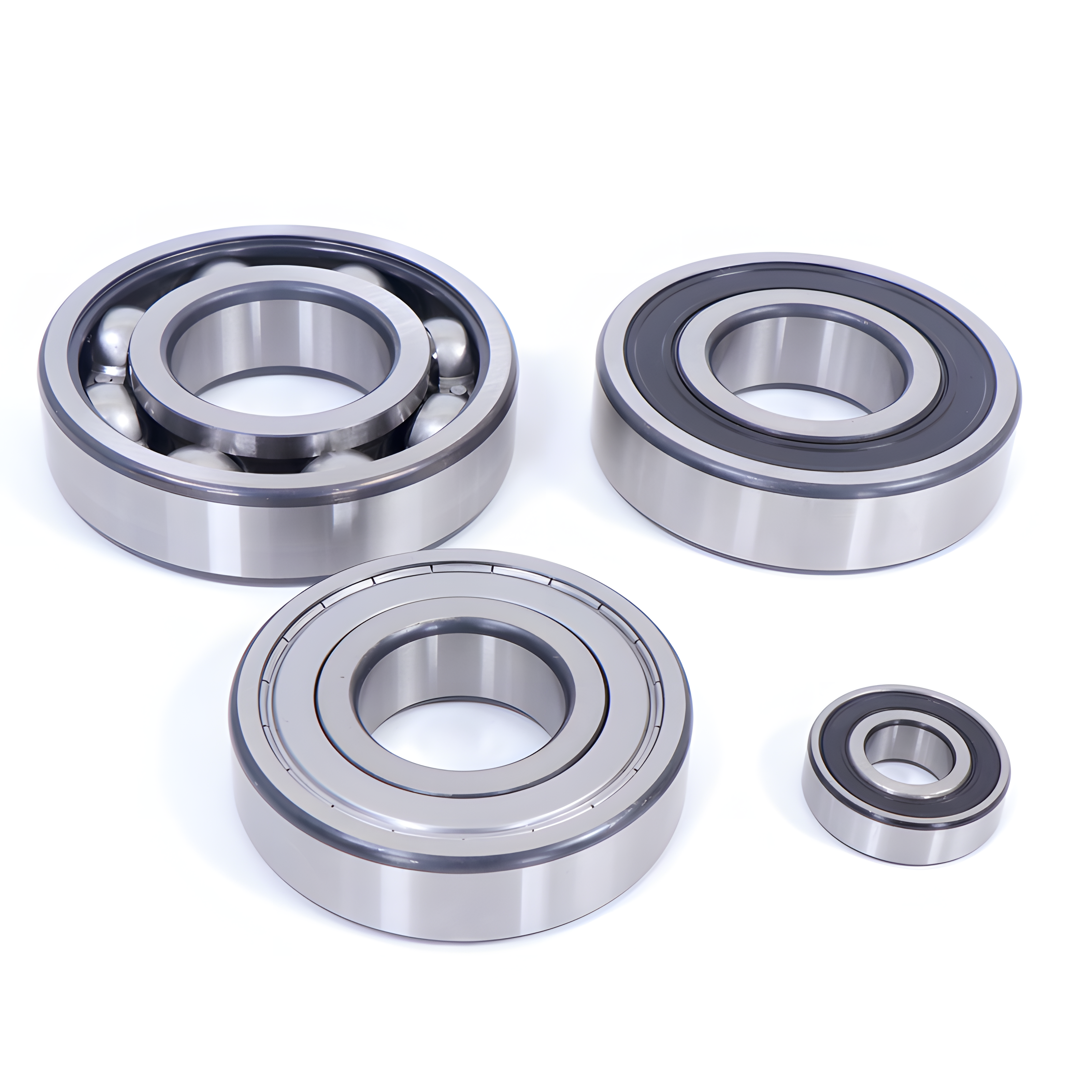
Can adding one extra ball row solve every bearing problem? It sounds logical, but machine design rarely works that way. More capacity can also mean more space, weight, heat, and cost.
Single row and double row deep groove ball bearings share a similar raceway design. However, they differ in structure, capacity, speed, stiffness, and installation needs.
In this guide, we compare both designs in practical terms. You will learn where each works best and what to check before ordering.
Table of Contents
Toggle
Quick Comparison
This table summarizes their main differences. Final values depend on the selected bearing and manufacturer.
Selection Factor
Single Row Design
Double Row Design
Ball Rows
One
Two
Radial Capacity
Moderate to high
Higher in a similar bore range
Axial Capacity
Moderate in both directions
Moderate in both directions
Rotational Speed
Usually higher
Usually lower
Bearing Width
Narrower
Wider
Weight
Lower
Higher
Stiffness
Standard
Greater radial stiffness
Alignment Sensitivity
Sensitive
Often more sensitive
Availability
Very broad
More limited
Typical Use
Motors, pumps, fans, gearboxes
Heavy drives, larger pumps, compact high-load assemblies
The double row design does not automatically replace two single row bearings. Shaft support, spacing, load direction, and housing geometry still matter.
What Is a Single Row Deep Groove Ball Bearing?
A single row deep groove ball bearing contains one ball row. The balls run between deep grooves in both bearing rings.
This structure mainly carries radial loads. It can also support moderate axial loads in either direction. Its compact design supports high rotational speeds.
The inner ring, outer ring, balls, and cage form one assembly. This non-separable structure simplifies handling and installation.
Single row bearings are available in many dimensions. Common model groups include 6000, 6200, 6300, and related sizes. Buyers can select open, shielded, or sealed versions.
Main Advantages
Compact dimensions
Broad model availability
Low rolling friction
Good high-speed performance
Simple installation
Multiple seal and clearance options
Suitable for radial and moderate axial loads
Common Applications
They are often used in:
Electric motors
Pumps and fans
Gearboxes and reducers
Conveyors
Power tools
Agricultural equipment
Automotive auxiliary systems
Their broad availability also simplifies replacement. However, the full model suffix must still match.
What Is a Double Row Deep Groove Ball Bearing?
A double row deep groove ball bearing contains two ball rows. Both rows operate inside one wider bearing assembly.
The structure can carry greater radial loads than a comparable single row design. It also provides higher radial stiffness for demanding equipment.
Double row deep groove ball bearings can support axial loads in both directions. Still, they are not designed for every heavy axial application. Angular contact or thrust bearings may perform better in those cases.
These bearings need more axial installation space. They also weigh more and may support lower speeds than smaller single row designs.
Main Advantages
Higher radial load capacity
Greater radial stiffness
Compact alternative to some two-bearing arrangements
Support for moderate axial loads
One-piece installation
Common Applications
They may be selected for:
Heavy industrial drives
Larger electric motors
Industrial pumps
Gearbox shafts
Agricultural machinery
Material-handling equipment
Compact high-load assemblies
Always confirm actual model availability. Double row sizes are less common than single row sizes.
Structural Differences
The ball count creates the main structural difference. Two rows distribute radial load across more rolling elements. They can increase capacity and stiffness, but may create more friction.
Double row bearings are also wider. They need more shaft space and different housing geometry. Cage design, clearance, and ball size further affect their performance.
Load Capacity: More Is Not Always Better
Load capacity often drives the final decision. However, buyers should separate static and dynamic ratings.
The dynamic load rating supports fatigue-life calculations during rotation. The static load rating relates to permanent deformation risk under heavy stationary loads.
A double row bearing usually offers greater radial capacity. Yet capacity depends on internal geometry and materials. Never compare designs using row count alone.
Example Selection Scenario
Consider a shaft using one single row bearing. The application later receives a larger radial load.
The designer may consider a double row replacement. Before changing it, they should check:
Required radial capacity
Existing housing width
Shaft shoulder position
Axial load direction
Continuous operating speed
Expected temperature
Lubrication method
Alignment accuracy
Example values require verification: A double row model may provide more radial capacity than one single row model. It may not equal two spaced single row bearings. Check confirmed manufacturer data.
Speed and Friction
Single row bearings usually suit higher rotational speeds. Their narrow structure creates fewer rolling contacts.
Double row bearings contain more balls and wider raceways. These features can increase friction and heat generation.
Seal design also affects speed. Open bearings often support higher speeds. Contact seals normally create more resistance.
Never use one universal speed value. Limiting speed depends on:
Bearing size
Seal design
Cage material
Internal clearance
Applied load
Lubricant
Operating temperature
Use the supplier’s technical data for final confirmation.
Space and Housing Requirements
A single row bearing offers the more compact option. It suits designs with limited shaft width.
A double row bearing uses more axial space. However, it may require less space than two separate bearings.
This advantage depends on the original arrangement. Two spaced bearings can resist moments differently. One double row bearing cannot always copy their support geometry.
Review the complete machine layout before changing designs. Check the shaft, housing, shoulders, seals, and retention method.
Misalignment and Installation Accuracy
Deep groove ball bearings allow only limited misalignment. Excessive shaft deflection can create uneven internal loading.
Double row bearings can be more sensitive to alignment errors. Both raceways must share the load correctly.
Installation errors may cause extra vibration, rising temperature, cage damage, and early fatigue.
Use accurate shaft and housing tolerances. Apply mounting force through the correct ring.
Never transmit installation force through the balls. It can damage raceways before operation begins.
Seal and Lubrication Options
Single row bearings offer broad sealing choices. Common options include open, ZZ, and 2RS designs.
Double row availability can be more limited. The offered seals depend on the specific model.
Design
Main Benefit
Main Tradeoff
Open
Low friction and external lubrication access
Limited contamination protection
ZZ
Light protection and relatively low resistance
Less protection against fine moisture
2RS
Stronger dust and moisture protection
More friction and lower possible speed
Grease selection should reflect load, speed, and temperature. Too little grease can reduce lubrication. Too much grease can raise temperature.
Internal Clearance
Internal clearance affects heat, noise, and bearing life. Installation fits can reduce the original clearance.
Operating temperature can change it again. Normal clearance suits many applications. C3 may suit tighter fits or higher temperatures, but it is not automatically better.
Single Row or Double Row: Application Guide
Application Condition
Recommended Starting Point
Reason
High speed and moderate load
Single row
Lower friction and broad availability
Limited shaft width
Single row
Narrower bearing design
Higher radial load
Double row
Greater radial capacity
Greater radial stiffness
Double row
Two ball rows support the shaft
Easy replacement sourcing
Single row
More common sizes and variants
Compact alternative to some paired bearings
Double row
Two rows inside one assembly
Significant misalignment
Neither by default
Consider a self-aligning design
High one-direction axial load
Neither by default
Consider angular contact or thrust designs
This table provides initial guidance. Final selection requires confirmed calculations.
How to Choose the Right Design
Confirm the Required Dimensions
Measure the shaft, housing bore, and available width. Check the existing bearing designation.
Calculate the Loads
Identify radial, axial, and shock loads. Determine whether they remain constant or change.
Check the Operating Speed
Record continuous and maximum speed. Compare them against verified technical limits.
Review Shaft Deflection
High deflection can create misalignment. It may shorten the life of both designs.
Select Seals and Lubrication
Review dust, moisture, temperature, and maintenance access. Then choose an appropriate seal and grease.
Confirm Clearance and Fits
Check shaft tolerance, housing tolerance, and operating temperature. These factors change working clearance.
Review Service and Replacement Needs
A high-capacity bearing offers little value when replacement becomes difficult. Check model availability and lead time.
Common Selection Mistakes
Avoid these common errors:
Choosing double row bearings only for “extra strength”
Ignoring housing width and shoulder positions
Comparing capacity without checking speed
Treating two single row bearings as one double row bearing
Selecting C3 without reviewing installed clearance
Ignoring shaft deflection and alignment
Copying load ratings between manufacturers
Ordering without the complete bearing suffix
Good selection starts with operating data. It does not start with the largest bearing.
Information to Send Your Supplier
Send complete details whenever possible:
Existing bearing number and suffix
Shaft and housing dimensions
Radial and axial loads
Continuous and maximum speed
Operating temperature
Dust and moisture conditions
Required service life
Seal preference
Clearance requirement
Precision or noise target
Required quantity
If the model is unknown, send a drawing or clear photo. Include visible markings and dimensions.
Frequently Asked Questions
Is a double row bearing always stronger?
It generally offers more radial capacity than a comparable single row design. Actual ratings still depend on the model and manufacturer.
Can one double row bearing replace two single row bearings?
Not automatically. Bearing spacing, moment loads, housing geometry, and shaft support must be reviewed.
Which design supports higher speeds?
Single row designs usually support higher speeds. Confirm the selected model, seal, cage, clearance, and lubricant.
Can both designs carry axial loads?
Yes. Both can support moderate axial loads in either direction. Heavy axial loads may require another bearing type.
Which design needs more installation space?
Double row bearings normally need more axial width. They may still use less space than two separate bearings.
Final Recommendation
Choose a single row bearing for compact size and higher speed. It also offers broad availability and flexible sealing options.
Choose a double row bearing when radial capacity and stiffness matter more. Confirm that the housing can accept its extra width.
Neither design is automatically superior. The right choice matches dimensions, load, speed, clearance, seals, and alignment.
VBA Bearing supplies deep groove ball bearings for motors and industrial machinery. Send us your application data for model and configuration support.
CTA: Send Your Requirements | Request Technical Data | Get a Quote
References and Further Reading
The following independent resources provide additional engineering guidance. They are not competing bearing suppliers.

 English
 العربية
 Français
 Русский
 Español
 Português
 Deutsch
 italiano
 日本語
日本語 한국어
한국어 Nederlands
 Tiếng Việt
 ไทย
ไทย Polski
 Türkçe
 ພາສາລາວ
 ភាសាខ្មែរ
 Bahasa Melayu
 ဗမာစာ
ဗမာစာ தமிழ்
தமிழ் Filipino
 Bahasa Indonesia
 magyar
 Română
 Čeština
 Монгол
 қазақ
қазақ Српски
 हिन्दी
 فارسی
فارسی Kiswahili
 Slovenčina
 Slovenščina
 Norsk
Norsk Svenska
 українська
 Ελληνικά
 Suomi
Suomi Հայերեն
 עברית
עברית Latine
 Dansk
Dansk اردو
اردو Shqip
Shqip বাংলা
বাংলা Hrvatski
 Afrikaans
 Gaeilge
 Oʻzbekcha
 Български
 ქართული